
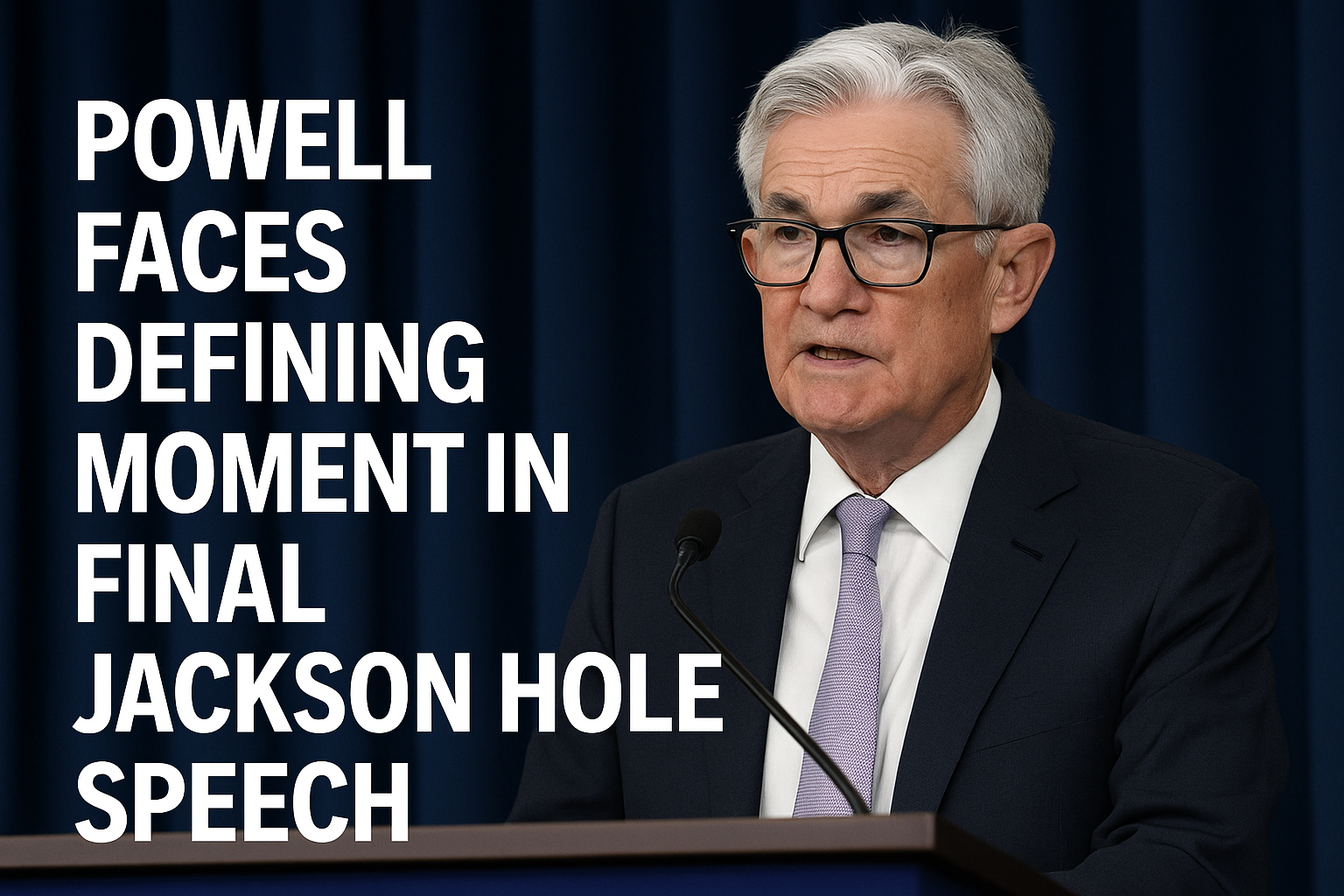
Federal Reserve Chair Jerome Powell is set to deliver his final address at the Jackson Hole Economic Policy Symposium today, in what many are calling the most consequential speech of his tenure. With just nine months left before his term expires in May 2026, Powell stands at the center of a storm—caught between political pressure, stubborn inflation, and slowing job growth.
A Legacy-Defining Stage
The theme of this year’s symposium, “Labor Markets in Transition: Demographics, Productivity, and Macroeconomic Policy,” highlights the very challenges the U.S. economy faces. Job growth is cooling, demographics are shifting, and productivity trends remain uncertain. Powell’s speech will not only set expectations for the September 16–17 Federal Open Market Committee (FOMC) meeting but also shape his legacy as Fed Chair.
Political and Market Pressures
The stakes have rarely been higher. President Trump has intensified his attacks on the central bank, openly demanding interest rate cuts and even calling for the resignation of Fed Governor Lisa Cook. These moves have raised concerns about the independence of the Federal Reserve at a critical moment for the U.S. economy.
Markets, meanwhile, are eagerly parsing every signal from Powell. Futures pricing shows a roughly three-in-four chance of a quarter-point rate cut in September, according to CME’s FedWatch tool. But with inflation still elevated and unemployment showing signs of weakness, investors remain unsure of which way Powell will lean.
The Fed’s Tightrope: Inflation vs Employment
The challenge for Powell is a classic one: inflation versus jobs. Core consumer prices rose 3.1% year-over-year in July, underscoring persistent inflationary pressure. At the same time, revised payroll numbers and weakening labor market data point to an economy that may be losing steam.
If Powell signals that inflation remains the priority, markets may see a delay in expected rate cuts. If he leans toward job support, investors could interpret his words as a green light for easing monetary policy next month. The wrong move risks either reigniting inflation or tipping the economy into recession.
Market Scenarios
- Dovish Powell: A strong hint at a September rate cut could spark a broad market rally, similar to the surge that followed last year’s Jackson Hole pivot.
- Balanced Powell: A cautious tone may disappoint investors, potentially triggering a short-term correction of 7–15%.
- Hawkish Powell: Emphasizing inflation risks and avoiding clear dovish signals could unsettle markets and push back rate-cut expectations.
What to Watch For
Analysts say investors should focus on four key signals in Powell’s remarks:
- Tone on inflation vs. jobs – Does he prioritize price stability or employment?
- Tariff references – Any mention of how tariffs are influencing inflation could hint at future policy shifts.
- Defense of Fed independence – With political pressure mounting, Powell may directly address the Fed’s autonomy.
- Longer-term framework hints – He could offer clues about potential changes in how the Fed views inflation targeting.
Bottom Line
Powell’s Jackson Hole address is far more than a policy update—it is a defining moment. With markets, politicians, and households all watching closely, his words could chart the course for monetary policy in the months ahead and cement his place in the history of the Federal Reserve.


